Contents
"Split a complex job that one AI agent can't handle across several agents" — that's the idea behind multi-agent systems. In 2026, designs that coordinate multiple AIs spread fast across research, development, and business automation.
But there's a big trap here. More agents doesn't mean smarter. In fact, 7 of 10 deployments reportedly add cost without ROI, and on sequential tasks Google research found multi-agent setups can perform 39-70% worse than a single agent. This article lays out the mechanics, the main patterns, and the major frameworks for beginners — and, most importantly, gives you the real decision rule for when to use multiple agents and when one is enough, without the hype.
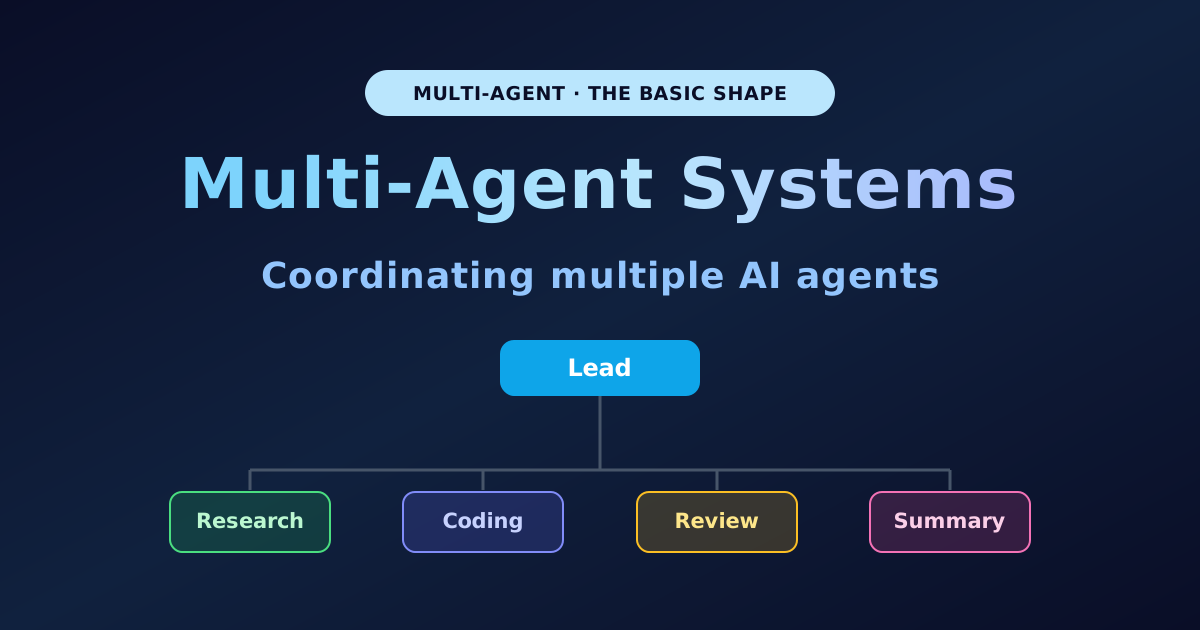
One lead directs a team of specialists
— Orchestrator-worker (the most widely adopted shape)
* Pattern names, framework traits, and figures in this article are quoted from public materials, surveys, and research reports (as of June 2026). Numbers vary by conditions and methodology — read them as directional.
1. What is a multi-agent system? vs a single agent
A multi-agent system is a setup where several AI agents with different roles work together to solve one large task. Versus a "single agent" that handles everything alone, it divides the work by specialty — research, coding, review, summarizing, and so on.
Single agent
One agent uses tools across the whole job. Simple, cheap, and easy to debug. Most real-world work (~80%) is fine with this.
Multi-agent
Roles are split, enabling parallel work and cross-checking. Strong on complex, multi-domain tasks, but coordination cost and token use spike.
The key is that it's the same idea as a human team. A team of specialists plus a coordinator handles bigger jobs than one generalist — but as headcount grows, so does the cost of communication and coordination. Exactly the same dynamic applies to AI. For the basics of a single agent, see what an AI agent is; for building one, the build guide.
2. The 4 main orchestration patterns
The design of "how to coordinate multiple agents" is called orchestration. In 2026 production deployments, four patterns dominate.
① 🧠 Orchestrator-worker (lead pattern)
A lead decomposes the work, dispatches it to specialist workers in parallel, and synthesizes results. Most widely used. Leaves an audit trail and is easy to debug.
② ➡️ Sequential handoff (baton relay)
When one agent finishes, it passes the context to the next. Suits one-track workflows. The flow is easy to follow.
③ 💬 Group conversation (debate)
Multiple agents debate in one thread, with a selector deciding "who speaks next." Strong for cross-verification and brainstorming.
④ 🕸️ Graph state machine (flow)
Agents are nodes, transitions are edges, and state is explicit. Strong for complex branching and resumption (checkpoints).
When in doubt, start with ① the lead pattern. Decomposition and synthesis are clear, and because there's an audit trail of which worker did what, isolating failures is easier. The A2A protocol that standardizes agent-to-agent coordination, and MCP for tool connections, are the foundational tech that supports these patterns.
3. Major frameworks compared
Multi-agent implementation frameworks proliferated in 2024-25 and consolidated into a few mature options in 2026. Know the character of these four.
| Framework | Traits | Best for |
|---|---|---|
| LangGraph | Graph + conditional edges. State save/rewind (checkpoints). Largest production footprint. | Enterprise production, complex flows |
| CrewAI | Role-based, the lowest learning curve (start in tens of lines). Production observability/recovery is weaker. | Rapid prototyping |
| AutoGen (AG2) | Conversational. Mature debate / cross-verification patterns. Strong research/academic adoption. | Research, verification-heavy |
| OpenAI Swarm | Specialized in explicit handoffs. Lightweight and simple. | Narrow handoff flows |
Source: various framework comparisons and official info (June 2026). Traits are tendencies; evaluations shift by version and use case.
A rough guide: "production = LangGraph, prototyping = CrewAI, research = AutoGen, lightweight handoffs = Swarm." But before picking a framework, always weigh the next question: should this even be multiple agents?
4. When to use it — and when one agent is enough
This is the most important part. Multi-agent isn't a cure-all; used in the wrong place it's "slow, expensive, and actually less accurate." Let's look at where it pays off and where it backfires, with data.
✅ Where it pays off
- Complex, multi-domain tasks (reports of up to +23% on reasoning benchmarks)
- Large refactors, migrations, multi-service development
- When you want to research in parallel and cross-check
⚠️ Where it backfires
- One-track sequential tasks (Google research: −39-70% vs single)
- Give a single agent the same compute and it often matches or wins
- Simple work where coordination overhead exceeds the gain
3 realities to know before adopting (reported figures)
deployments added cost
without ROI (reported)
token consumption
(vs single, a guide)
avg ROI when aimed well
(top quartile 4-6x)
* Figures quoted from surveys and research, condition-dependent. The reality: "big when it lands, but a cost sink when it misses."
In short: "aimed at complex work it's big, but on simple work it backfires and just inflates cost." Which is exactly why the following way of starting matters.
5. How to start (single first, add agents later)
Expert advice is nearly unanimous: "build with a single agent first, and only add more once you hit a limit." Going multi from the start is usually over-engineering. For the concrete build steps, see how to build a multi-agent system.
Build with a single agent first
~80% of use cases are fine with one. Cheap, fast, easy to debug. Put measurement in place too.
Identify a concrete "ceiling"
Only once it's clear: "roles blur and accuracy drops," or "parallelizing would be faster" — a problem that splitting actually solves.
Start minimal with the lead pattern
Begin with a small team of 2-3 in the ① orchestrator-worker shape. Always set a cost cap and logging.
Measure whether it's worth it
Compare the accuracy gain against the cost increase (~15x tokens). Have the courage to revert to a single agent if it doesn't pay off.
On safety, the more agents you add, the more paths there are for runaway behavior and misfires. Set up guardrails, security measures, and evaluation (evals) at the same time as going multi. For concrete business applications, see the 10 use cases.
Summary
Multi-agent is a powerful design for solving complex problems with a team of specialists — but also a tool you must aim carefully.
Key takeaways
- 👥 Coordinates multiple specialist agents. Same dynamics as a human team.
- 🧠 4 main patterns (lead / sequential / debate / graph). When unsure, start with the lead.
- 🛠️ Frameworks consolidated to production=LangGraph, prototyping=CrewAI, etc.
- ⚠️ Not a cure-all: +23% on complex work, but −39-70% on simple sequential, ~15x tokens, 7 in 10 a cost sink.
- 🚀 Start single. Add agents minimally only after you hit a limit.
"Single for 80%, multi only for the hard parts." Keep that distance and you avoid runaway cost while unlocking multi-agent's power on the genuinely complex jobs. Start by building a solid single agent first. For how to actually divide the work in Claude Code itself, the comparison of built-in Subagents vs Agent Teams is a useful reference.
FAQ
Q. Do more agents make it smarter?
A. No. Accuracy rises on complex, multi-domain tasks, but on simple sequential tasks Google research reports −39-70% vs a single agent. What matters is not the count but "whether the task can be solved by splitting."
Q. Which framework should I pick first?
A. LangGraph for production, CrewAI to try things quickly, as a guide. But before choosing a framework, decide first whether you truly need multiple agents — most use cases are fine with one.
Q. How is this different from A2A and MCP?
A. Multi-agent is the design philosophy of "how to coordinate multiple AIs." A2A is the communication protocol for agents to talk to each other, and MCP is the protocol for tool connections — both are foundational tech that supports multi-agent.
Q. How much does cost go up?
A. Reports put token consumption at ~15x vs a single agent. Cost controls like caching, trimming communication, and memory compression are essential. Always measure whether the accuracy gain justifies the increase.