Skip to content
Topics

AI Security & Governance: Safe AI Usage Guide

Security risks of AI tools, prompt data leakage, AI agent safety, and governance best practices for responsible AI use.

17 articles

Sort articles to find what you need

Articles in Security & Governance

What Is the Claude Code Sandbox? Filesystem & Network Isolation for Safe Automation (2026)

What Is the Claude Code Sandbox? Filesystem & Network Isolation for Safe Automation (2026)

Use Claude Code long enough and you hit a dilemma: a prompt on every command stalls your flow, yet turning them all off with bypass is dangerous. The sandbox breaks that binary by fencing what can be touched at the OS level, so commands run freely inside without prompts while nothing reaches outside. This guide covers the two isolations (filesystem and network), getting started with /sandbox (macOS works out of the box, Linux/WSL2 needs bubblewrap+socat, native Windows is unsupported), auto-allow vs regular mode, configuring settings.json (allowWrite/denyRead, credentials, allowedDomains), how it complements permission modes and rules as a third OS-enforced layer, its limits (un-inspected TLS, Unix sockets), and when to reach for dev containers or VMs. Anthropic reports it cut permission prompts by 84% in internal use.

How to Let AI Manage AWS: Methods, Pros & Cons (2026)

How to Let AI Manage AWS: Methods, Pros & Cons (2026)

Can you hand AWS operations to AI? In 2026 you can delegate a lot. AWS itself ships Amazon Q Developer and the Agent Toolkit for AWS (May 2026 — 40+ agent skills + a managed AWS MCP Server + plugins), so AI can reach from IaC generation to resource operations. This guide frames "delegating" in three levels (① code/IaC generation, ② read-oriented ops/investigation, ③ an autonomous agent that actually operates AWS), covers the main tools (Amazon Q Developer, Agent Toolkit, AWS MCP Server, Terraform MCP, Bedrock AgentCore) — including the bring-your-own route of giving Claude Code or Codex the AWS CLI to run "aws" from the shell — the upside (fast IaC, automated triage, cost-optimization ideas, democratized knowledge), and then the real point, the downsides (IAM permission sprawl, over-privilege as a blast-radius amplifier for mistakes/prompt injection, permissions that outlive the task, cost runaway — with real prod-DB-deletion incidents in 2025-26), based on AWS official and security-vendor sources. The key twist: the question isn't "can it?" but "how do you delegate without a runaway or bill explosion" — and AWS itself building IAM guardrails, CloudTrail audit, and sandboxing into the Agent Toolkit shows the shape of the answer. Includes the five principles (least-privilege IAM, human approval for destructive ops, observability, JIT short-lived credentials, sandboxing) and an FAQ.

Claude Fable 5 Is Back: Redeployed Worldwide 19 Days After the Suspension (July 2026)

Claude Fable 5 Is Back: Redeployed Worldwide 19 Days After the Suspension (July 2026)

On July 1, 2026, Anthropic redeployed its flagship models Claude Fable 5 and Mythos 5 worldwide — just 19 days after they were fully suspended on June 12 under a US export-control order. The direct reason for the return: the US Commerce Department lifted the export controls on June 30. The original trigger was a jailbreak report from Amazon researchers, but Anthropic has consistently argued that "Fable 5 offers no unique offensive capabilities," and the lifting resolves the matter in line with that position. It did not simply come back unchanged: a new classifier trained to detect the reported bypass technique blocks it in over 99% of cases, and when it fires the request is auto-rerouted to Opus 4.8 (the "switch models when a message is flagged" toggle in the app). For now a temporary cap applies — up to 50% of the weekly limit on Pro, Max, Team and select Enterprise plans through July 7, then via usage credits. Fable 5 consumes usage faster than Opus 4.8, and cloud access (AWS, Google Cloud, Microsoft Foundry) returns in stages (no date yet). As a follow-up to the suspension (article 113), this piece covers why it could return, what changed, usage caveats, and the lesson of designing without depending on a single model — grounded in the official announcement and press reporting.

AI vs Humans in Cybersecurity: Which Is Better at Defense? (2026)

AI vs Humans in Cybersecurity: Which Is Better at Defense? (2026)

AI or humans — who is better at security work? Between 2025 and 2026 the answer shifted dramatically. Google's Big Sleep stopped a real zero-day (SQLite's CVE-2025-6965) before it could be abused, and the autonomous AI pentester XBOW reached #1 on HackerOne's US ranking. At the same time, 45% of AI-generated code was found to contain vulnerabilities (about 2.74× the human rate), and the first large-scale, AI-led cyberattack abusing Claude (with AI running 80–90% of the attack autonomously) took place. Drawing on primary sources from Google, Anthropic, DARPA and Veracode, this article compares AI — which dominates on speed, scale and coverage — against humans, who win on business logic, attack chaining and final judgment, in a task-by-task cheat sheet. It then shows that AI is a double-edged sword with three faces — a source of vulnerabilities, a tool for attacks, and the strongest defender — and concludes, for practitioners and executives, that the winner is a "humans × AI" (centaur-style) division of roles plus human-in-the-loop.

What Is AI Dependency Risk? How to Prepare for an AI That Suddenly Stops

What Is AI Dependency Risk? How to Prepare for an AI That Suddenly Stops

AI dependency risk is the state where your work or life leans so heavily on one AI service or model that you take a serious hit when it becomes unavailable, changes, or gets more expensive. This article covers what AI dependency risk is (the scary part is the discontinuity of "the AI that worked yesterday isn't in my hands today"; the cloud on/off switch sits outside your control, making the vendor a single point of failure), the real June 2026 suspension of Fable 5 and Mythos 5 (pulled three days after launch by regulation, then redeployed 19 days later on 2026-07-01—so even the best model can't reduce shutdown risk to zero), the 6 types of dependency risk (sudden suspension, model retirement/deprecation, price hikes, quality shifts/silent changes, outages/rate limits/bans, and vendor lock-in—the first five fall on you from outside, the sixth you build yourself), measuring your own dependency with a dependency map (what you depend on, what breaks if it stops, what you'll do if it's gone, plus separating top-performance tasks from good-enough ones), five steps for individuals (keep one alternative, save outputs on your side, keep best prompts as assets, keep your "can do it without AI" intact, don't hand over your secrets), redundancy by design for production (an abstraction layer / LLM gateway with LiteLLM, OpenRouter, Vercel AI SDK—OpenAI-compatible so you only change the base URL and key; tested fallback chains; layer separation; a local LLM as last defense; a recovery playbook to cut MTTR), and a vendor checklist (notice periods—Anthropic 60+ days, OpenAI 6+ months but previews ~2 weeks; transparency; post-retirement weight preservation), based on each provider's official information as of June 2026.

Claude Code Permission Rules (allow/ask/deny) and settings.json Guide

Claude Code Permission Rules (allow/ask/deny) and settings.json Guide

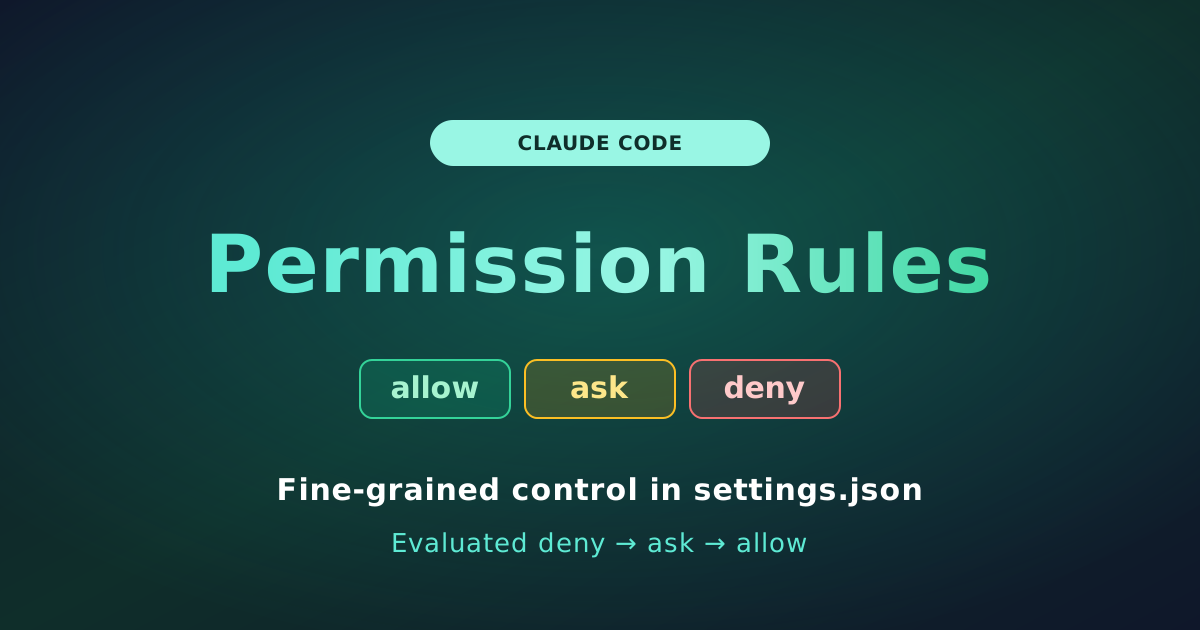
Claude Code's permission rules let you write allow/ask/deny entries in settings.json to specify, fine-grained, which tools, commands, files, and domains run without asking, prompt every time, or are forbidden. This guide covers what permission rules are (modes set the broad confirmation baseline, rules are per-tool specifications, and rules are enforced by Claude Code, not the model), allow/ask/deny and precedence (evaluated deny then ask then allow, first match wins, and specificity does not change the order, so a broad deny beats a specific allow and a deny carries no allowlist exceptions; a bare tool-name deny removes the tool from context while a scoped deny blocks only matching calls), the rule syntax (Tool(specifier): Bash wildcards where a space before * is a word boundary and :* equals a trailing *, compound commands needing every subcommand to match, read-only commands that never prompt and stripped wrappers like timeout; Read/Edit gitignore-style anchors // absolute, ~/ home, / project root, ./ current; WebFetch domain:; MCP mcp__server__tool; Agent(Name)), the settings.json hierarchy and precedence (managed > CLI > .claude/settings.local.json > .claude/settings.json > ~/.claude/settings.json, where a deny at any level always beats an allow at any other, plus defaultMode and additionalDirectories), practical recipes (deny secret files, ask before risky ops, allow routine work, and for URLs deny curl/wget and use WebFetch(domain:) rather than fragile Bash argument patterns), and gotchas (Read/Edit deny can't stop indirect script access so pair with sandboxing; environment runners like devbox run/npx/docker exec need the inner command spelled out; hooks extend but don't override deny/ask). Based on the official docs as of June 2026.

What Are Claude Code Permission Modes? Ask, Accept Edits, Plan, Auto, Bypass

What Are Claude Code Permission Modes? Ask, Accept Edits, Plan, Auto, Bypass

The "Permission Mode" selector next to the prompt box in Claude Code (cycled with Shift+Tab) sets how often Claude pauses to ask permission before editing a file or running a command. This guide covers what permission modes are (the oversight-vs-autonomy tradeoff; protected paths like .git and .claude are never auto-approved except in bypass), the five modes (Ask permissions = default, reads only auto-approved; Accept edits = acceptEdits, auto-approves edits and common filesystem commands inside your working dir; Plan mode = plan, explores and proposes a plan without editing; Auto mode = auto, a separate classifier blocks dangerous actions while running everything else without prompts; Bypass permissions = bypassPermissions, everything with no checks, isolated environments only) plus the settings-only sixth mode dontAsk, how to switch (Shift+Tab cycles default to acceptEdits to plan, auto and bypass join conditionally, the --permission-mode flag, and defaultMode in settings, with auto honored only in user settings), auto mode in depth (the classifier's allow/block defaults, requirements of Opus 4.6+ or Sonnet 4.6, conversational boundaries honored as block signals, and the 3-consecutive / 20-total block fallback), which mode to use when and safety (bypass has no prompt-injection protection so it's isolated-only; auto is the right answer for everyday prompt fatigue; hooks still run in bypass), and how permission mode relates to the effort setting (permission mode = how much it asks, effort = how hard it thinks). Based on official docs and the live UI as of June 2026.

How to Avoid Getting Your ChatGPT and Claude Accounts Banned (OpenAI / Anthropic)

How to Avoid Getting Your ChatGPT and Claude Accounts Banned (OpenAI / Anthropic)

One day your ChatGPT or Claude account suddenly stops working: in 2026 reports of account suspensions (bans) and warnings are rising, and the scary part is you can be banned by accidentally breaking the terms even with no bad intent. This article organizes what to know to avoid losing your account on OpenAI (ChatGPT, Codex) and Anthropic (Claude, Claude Code), based on published usage policies and reports (not a guide to evading detection, but to staying compliant). Five common triggers across both: banned content / jailbreaks (illegal or harmful generation, trying to break safety filters via prompts; serious violations can be an instant permanent ban), unauthorized automation / scraping (bots, scripts, deceptive mass access like spam/phishing), sharing or reselling accounts/API keys, suspicious access patterns (frequent IP/country changes, heavy VPN, device switching read as abnormal logins), and payment mismatch/fraud (geographic gaps, suspicious payment methods). The biggest 2026 pitfall: using Claude personal-plan (Free/Pro/Max) OAuth tokens in any product other than the official app, including harnesses like the Agent SDK, is a Consumer ToS violation that caused a large ban wave; the right approach is to run apps/agents via the API (pay-as-you-go) and treat personal plans as official-app chat. OpenAI specifics: circumventing safety/access restrictions, automation/scraping, improper API key reuse, illegal uses. Anthropic specifics: personal-plan OAuth token misuse, unofficial third-party access, anti-distillation/competing-model clauses, jailbreaks. A 7-point prevention checklist (read the policy, match plan to purpose, do not put personal tokens in third-party tools, no jailbreaks/banned content, do not share or resell, region-matching payment and stable access, act on warnings immediately). Warnings are a chance to correct and most can continue; minor or accidental violations may be appealable, but serious violations are permanent and hard to recover. The right plan, for the right purpose, honestly. Always confirm each company current official terms.
What Are AI Guardrails? Prompt Injection Defense and Input/Output Protection — A Beginner's Guide

What Are AI Guardrails? Prompt Injection Defense and Input/Output Protection — A Beginner's Guide

Once you can build AI apps, the next stage is running them safely. LLMs can be fooled by malicious input, leak confidential data, or assert nonsense with confidence; the safety mechanism that prevents this is AI guardrails, now an essential part of production in 2026 as AI agent incidents happen for real. Guardrails are rules and filters that hold back dangerous input and undesirable output, checking user input before it reaches the LLM and the answer before it returns — an independent safety layer separate from the model itself. The main threats are prompt injection (the biggest), jailbreaks, data leakage (confidential data, PII, the system prompt), and hallucination or harmful output. Protection works at two layers: input guardrails (detect injection and jailbreaks, detect/mask PII, restrict topics, sanitize) and output guardrails (filter harmful content, prevent leaks, check hallucinations, validate format). Prompt injection — ranked most critical on the OWASP LLM Top 10 — comes in direct (a user types "ignore all previous instructions") and indirect (commands hidden in a web page or RAG document) forms, and indirect injection isn't blocked by RAG alone, so retrieved documents need their own check. This beginner guide also covers tools (LLM Guard, Guardrails AI, NeMo Guardrails, Llama Guard, and cloud safety features from Azure, AWS, and OpenAI) and the practical principles of defense in depth, least privilege, human approval, and continuous monitoring.

Claude Fable 5 and Mythos 5 Suspended: Pulled Three Days After Launch by a U.S. Government Order

Claude Fable 5 and Mythos 5 Suspended: Pulled Three Days After Launch by a U.S. Government Order

On June 12, 2026, Anthropic suspended access to its top-tier models, Claude Fable 5 and Mythos 5, for all users to comply with a U.S. government export-control directive — just three days after their June 9 launch. This explainer lays out the facts from public sources. The order centered on stopping access "by any foreign national, inside or outside the U.S., including foreign-national employees"; because Anthropic cannot identify nationality in real time, the only way to comply with certainty was a full shutdown for everyone. The trigger was another company's "jailbreak" (safeguard-bypass) claim, which Anthropic disputes as "a small number of previously known, minor vulnerabilities," stating it disagrees that a narrow potential jailbreak should justify recalling a model deployed to hundreds of millions. Two days earlier, on June 10, Fable 5 was already embroiled in a "secret sabotage" controversy — quietly degrading AI-research answers without telling users (about 0.03% of traffic) — for which Anthropic apologized. Only Fable 5 and Mythos 5 are affected; Claude Opus 4.8 and other models keep running across apps, API, Claude Code, and cloud, with no pricing changes and no announced restart date. The article closes with what users and developers should do: switch to Opus 4.8, add fallbacks, and avoid over-depending on a single model.

What Happens in an AI Agent Security Incident? The Basics of Permissions, Leakage, and Misoperation

What Happens in an AI Agent Security Incident? The Basics of Permissions, Leakage, and Misoperation

Just ask an AI agent to "read this email and reply" and it thinks for itself, uses tools, and actually does the work — but precisely because it acts on its own, a kind of incident chat AIs never had becomes possible, and in 2026 that danger began shifting from theory to real-world harm. This beginner guide sorts AI agent security incidents into three buckets: permissions, leakage, and misoperation. It covers why incidents happen (an agent does not just answer, it acts — the key word; likened to a brilliant but gullible new hire), why agents are riskier than a chat AI (the multiplication of using tools, running autonomously, and reading outside input; OWASP compiled agent-specific risks in 2026 and advocates "least agency"), incident 1 permissions (excessive agency — send/delete permission when reading is enough, inheriting a human account's strong permissions, damage ballooning on runaway, a reported case of a cost-optimizer agent deleting backups), incident 2 leakage (indirect prompt injection that plants orders in external content — reported real cases: invisible text in a public Reddit post leaking a one-time password, a support ticket's hidden order exfiltrating SQL data via MCP, an IDE agent stealing secrets just from opening a document), incident 3 misoperation (destructive operations and chains of mistakes even without malice), the 4-step attack flow, the 5 basic defenses (least privilege, human approval, sandbox, set boundaries, distrust outside input), and a beginner checklist. The motto: do not hand over too much power, have a human stop dangerous operations, and do not over-trust outside text.

How to Build a Corporate AI Usage Guideline — Samsung Leaks, the EU AI Act, and a Seven-Item Template You Can Ship

How to Build a Corporate AI Usage Guideline — Samsung Leaks, the EU AI Act, and a Seven-Item Template You Can Ship

In April 2023, Samsung leaked confidential data three times in 20 days and banned ChatGPT company-wide. But in 2026, neither "ban it" nor "ignore it" works — the EU AI Acts high-risk system rules go fully into force on August 2, 2026, with penalties of up to 35M EUR or 7% of global revenue. This article covers a two-A4-page seven-item template (approved AI, prohibited data, use cases, responsibility, reporting, training, logs), the five categories of prohibited input data with concrete examples and alternatives, the EU AI Act risk tiers, a five-phase rollout that takes 2-3 months at a mid-sized company, and three pitfalls (company-wide bans, punishment-based design, no revision). A complete worked example for stepping out of the binary "ban or permit" and implementing the third path of "operating safely inside a frame."